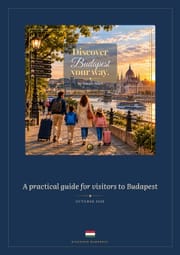
Inside the opening chapter
Budapest is a city that was once three: hilly Buda on the west bank of the Danube, flat and lively Pest on the east, and ancient Óbuda to the north, united only in 1873. Today the Danube runs through the middle of the capital like a wide, silver boulevard, and ten bridges stitch the two banks together. On one side a royal palace crowns a ridge; on the other a neo-Gothic Parliament glows on the water’s edge. In between are tram lines, coffee houses, courtyard bars and some of the most beautiful public baths in Europe.
Budapest is easy to enjoy. The compact centre is walkable, the public transport is dense and clear, and the city rewards curiosity: a stairwell in a nineteenth-century apartment block may open onto a leafy courtyard, and a plain door may lead to a Turkish-era bath. Hungary is a member of the European Union and the Schengen Area, but it has kept its own currency, the forint, so remember to plan for that.
Think of Budapest as two cities that complement each other: Buda for views, history and green hills; Pest for architecture, food, culture and nightlife. Try to sleep on one side and spend long stretches on the other, crossing a bridge on foot at least once a day.
What's inside the full guide
- Welcome to Budapest
- Budapest at a glance
- Which Budapest is yours?
- When to go and what the weather means
- How long to stay and what to pack
- One day in Budapest
- Two and three days
- Five days and a week
- Rainy-day and winter plan
- By air
- By train, coach and car
- The metro
- Trams, buses, boats and tickets
- Taxis, walking and cycling
- Accessibility
- The districts for visitors
- Hotels, apartments and hostels
- Belváros and Lipótváros
- Terézváros, Erzsébetváros and Józsefváros
- Buda: Víziváros, Gellért Hill and Óbuda
- Buda Castle and Castle Hill
- Matthias Church and Fisherman’s Bastion
- Gellért Hill and the Citadella
- The Hungarian Parliament
- St Stephen’s Basilica and the Opera
- Andrássy Avenue and Heroes’ Square
- History from Aquincum to today
- Coffee houses and the literary city
- Religion and the city of many faiths
- Hungarian language, music and folk heritage
- Choosing museums well
- Opera, theatre and music
- Active Budapest: hills, water and bikes
- Day trips from Budapest
- The Danube Bend
- Eger, Gödöllő and Lake Balaton
- What to eat in Budapest
- Cakes, coffee houses and sweets
- Wine, pálinka, beer and Unicum
- Etiquette, budgets and diets
- Markets and street food
- Evenings out
- Budapest through the year
- Shopping in Budapest
- Souvenirs and tax-free shopping
- Money, cards and tipping
- Language and useful phrases
- Safety, scams and etiquette
- Health, pharmacies and emergencies
- Staying connected and responsible travel
- Before you go and your first day
Budapest: City bundle — Expat + Travel (€29.90)
Save €9.90 compared to buying separately.
Pair it with the sibling guide
 A New Chapter in Budapest – Expat Guide (66 pages) →
Frequently asked questions
What is included in the free Budapest starter guide?
The free 10-page A4 PDF includes the cover, table of contents, and opening chapters so you can judge the depth and layout before deciding on the full 70-page edition.
Can I read and print the Budapest PDF on any device?
Yes. Every Smart Start guide is formatted as a clean A4 PDF (October 2026 edition) that works offline on phones, tablets, laptops, and home printers with no password required.
Is there a bundle with both the Expat and Travel guides for Budapest?
Yes — the Budapest City Bundle includes both the Expat and Travel full PDFs for €29.90 (saving €9.90 compared to buying them separately).
 Vienna
 Barcelona
 Prague
 Stockholm
 Berlin
 Paris
 Rome
 London
 Sofia